Contact lenses can feel comfortable in the morning and irritating by late afternoon. Air conditioning, screen use, dust, and reduced blinking may disturb the eye’s tear film. Lens Comfort Drops are designed to improve this experience by adding moisture around the lens surface. They may reduce friction during blinking and help the lens feel smoother against the eye.
Most comfort drops contain lubricating ingredients, such as polymers that help water remain on the lens longer. Some are formulated specifically for contact lens wearers. Others may not be suitable for use while lenses are inserted, so the label matters. A few drops can make a dry lens feel less noticeable within minutes, although the effect may be temporary. They do not replace proper cleaning, regular lens replacement, or professional eye care.
The mechanism sounds simple, but comfort is not identical for everyone. One person may benefit from a preservative-free formula, while another may need a different lens material or wearing schedule. Persistent redness, pain, light sensitivity, blurred vision, or unusual discharge should not be covered up with drops. These symptoms require prompt advice from an eye-care professional. Lens Comfort Drops can support daily comfort, but they are not a cure for every cause of irritation. It is easy to expect too much from them. Careful product selection remains important.
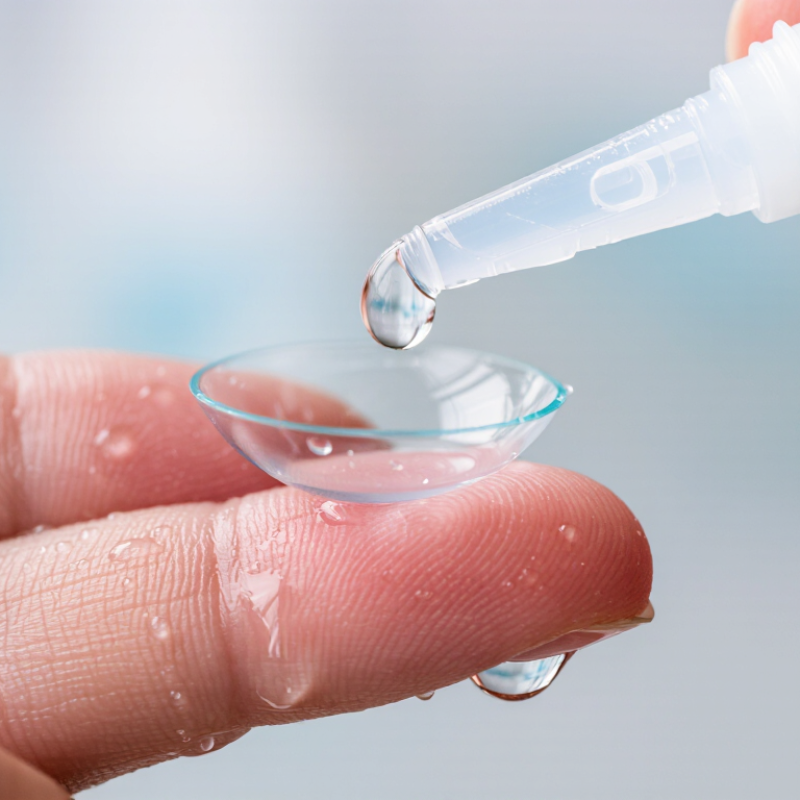
Lens comfort drops are sterile ophthalmic lubricating products designed to ease dryness during contact lens wear. In the United States, many are regulated by the Food and Drug Administration as over-the-counter ophthalmic demulcents. This means their active ingredients, labeling, manufacturing, and safety requirements follow established FDA rules. It does not mean every bottle receives individual FDA approval before sale.
Look for wording such as “rewetting drops” or “for use with contact lenses.” Check the active ingredients and expiration date. A drop may contain lubricants that help spread moisture across the lens surface. This can reduce friction when blinking. The relief is often temporary. That matters.
Apply drops with clean hands and avoid touching the bottle tip. If a lens feels gritty, remove it before using a product not labeled for lens wear. Some preserved formulas may irritate sensitive eyes, especially after frequent use. Single-use containers can be useful here.
Do not use comfort drops to mask pain, light sensitivity, discharge, or sudden blurred vision. Those symptoms need professional evaluation.
Read the label carefully. I sometimes find the wording confusing, even as a careful reader. “Redness relief” is not the same as lubrication. Contact an optometrist or ophthalmologist when discomfort continues, because poor lens fit, deposits, allergy, or infection may be involved.
Lens comfort drops are designed to support the tear film around a contact lens. Their formulation often considers tear osmolarity, which describes the concentration of dissolved salts and other particles. Healthy tears commonly measure near 275–300 mOsm/L, although values vary between people and testing conditions.
A drop close to this range may feel more natural on the eye. It can reduce the sudden stinging caused by a solution that is too concentrated or too diluted. That balance matters. Formulators may adjust sodium, potassium, chloride, and other electrolytes to approach tear-like conditions.
They also consider pH, viscosity, and surface tension. A slightly thicker drop may remain under the lens longer, but excessive thickness can blur vision or create a sticky sensation.
Osmolarity is only one part of comfort. A person may still experience dryness from low blinking, air conditioning, screen use, or an unsuitable lens fit. Preservative choice also matters, especially for frequent users or sensitive eyes. Clinical measurements can guide care, but one reading should not control every decision. It is not magic.
In practice, an eye-care professional may assess lens movement, tear volume, staining, and symptoms together. If a drop causes persistent burning, redness, or blurred vision, stop using it and seek professional advice. Even a well-balanced formula may not suit every eye.
What Are Lens Comfort Drops and How Do They Work?
Lens comfort drops support the tear film when lenses create friction, dryness, or an unstable wetting layer. The TFOS International Workshop on Contact Lens Discomfort reported that roughly 30–50% of lens wearers experience discomfort. That figure shows the problem is common, not necessarily simple.
Hyaluronic acid attracts and holds water across the lens surface. Its viscoelastic texture can create a smoother cushion during blinking. HPMC, or hydroxypropyl methylcellulose, adds gentle viscosity. It helps the liquid remain longer between the lens and cornea. Together, these ingredients may reduce the scratchy feeling caused by incomplete blinking, screen use, or low humidity. The TFOS DEWS II report also identifies tear-film instability as a major factor in dry-eye symptoms. Still, the chemistry is not magic. A drop cannot correct a damaged lens, poor fit, allergy, or an untreated eye condition.
Tips: Check that the drops are approved for contact-lens use. Add one drop before discomfort becomes intense. Blink slowly several times. Replace lenses as directed, and stop wearing them if pain, redness, or blurred vision continues. Individual results vary. That matters. A short trial, guided by an eye-care professional, is more reliable than chasing instant comfort.
Hyaluronic acid and hydroxypropyl methylcellulose (HPMC) are common ophthalmic lubricants. They help improve tear-film lubrication by retaining water, increasing fluid viscosity, and supporting a smoother ocular surface.
The chart shows representative concentration ranges commonly encountered in ophthalmic lubricant formulations: approximately 0.1–0.3% for hyaluronic acid and 0.3–0.5% for HPMC. Concentration alone does not determine comfort; molecular properties, formulation viscosity, retention time, preservatives, and individual eye conditions also influence performance.
Lens comfort drops are lubricating solutions designed for contact lens wearers. They add moisture between the lens and the eye’s surface. This can reduce friction, dryness, and the scratchy feeling that develops after several hours. Some drops also help refresh the tear film, which supports smoother blinking and clearer vision.
Preservatives deserve closer attention during repeated lens wear. They help prevent microbial growth after a bottle is opened, but some may irritate the eye with frequent use. Repeated exposure can disturb the tear film or cause burning in sensitive wearers.
Not always. The effect depends on the preservative, concentration, wearing schedule, and individual eye health. A preservative-free formula may suit people who use drops several times daily, although single-use containers require careful handling and proper disposal.
The simple advice is not always complete. Preservative-free does not mean every product fits every lens or eye condition. Check that the instructions specifically allow use with contact lenses, and never use redness-relief drops as a substitute for lubrication. Wash and dry your hands before applying drops. If discomfort continues, remove the lenses and seek professional eye care, especially with pain, marked redness, discharge, or blurred vision. A small bottle can improve comfort, but it cannot correct an unsuitable lens fit or an untreated eye problem.
What Are Lens Comfort Drops and How Do They Work?
How FDA Guidance and ISO 18369 Evaluate Lens-Drop Safety
Comfort drops are sterile ocular solutions designed to reduce friction between a lens and the tear film. They may replenish moisture, dilute deposits, and improve blinking comfort. Relief can arrive quickly. It can also fade quickly. FDA safety review considers intended use, formulation, sterility, container integrity, labeling, and lens compatibility. Preservatives matter because repeated exposure may irritate sensitive eyes. FDA guidance also expects evidence supporting performance and safe use, rather than comfort claims alone.
ISO 18369 provides internationally recognized terminology and test methods for contact lenses and materials. Its framework helps assess dimensions, tolerances, and physicochemical properties, including water-related behavior. However, ISO 18369 does not independently approve every comfort drop. That distinction is easy to miss. A compliant lens standard cannot replace product-specific clinical and microbiological evidence. The CDC reported nearly one million U.S. outpatient visits for keratitis annually, using national data from 2005–2011 (MMWR, 2016). Poor hygiene, overwear, and unsuitable products can increase risk.
Tips: Check the label for lens compatibility and discard instructions. Wash and dry hands before handling lenses. Never use saliva or tap water. Stop wearing lenses if pain, redness, light sensitivity, or blurred vision appears. Seek professional care promptly. In practice, “soothing” is not the same as “safe for everyone.”
| Evaluation dimension | How comfort drops work | FDA-oriented safety considerations | Relevance of ISO 18369 | Typical evidence or check |
|---|---|---|---|---|
| Product purpose | Adds a temporary lubricating layer and refreshes the tear film around a contact lens. | The intended use and claims should be clearly defined, such as temporary relief of dryness or discomfort associated with lens wear. | Provides terminology and technical context for contact lenses and related care products; it does not independently authorize a product for sale. | Intended-use statement, product classification assessment, and substantiation for comfort claims. |
| Lubricating ingredients | Water-soluble polymers and humectants can retain moisture, reduce friction, and improve lens wettability. | Ingredients should be suitable for ophthalmic use at the stated concentration and should not introduce unacceptable irritation or toxicity. | Supports consideration of interactions between the drop, lens material, surface properties, and wearing conditions. | Ingredient review, ocular irritation assessment, compatibility testing, and measurement of wetting or friction-related performance. |
| Sterility | The drop is placed directly onto or near the eye, so microbial contamination can create a serious risk. | Ophthalmic products are generally expected to be sterile and manufactured, packaged, and tested under controls that maintain sterility through the labeled shelf life. | ISO 18369 provides contact-lens-related technical requirements and test concepts, but sterility assessment also relies on applicable ophthalmic product and microbiological standards. | Sterility testing, validated sterilization or aseptic processing, container-closure integrity, and in-use contamination controls. |
| Preservatives | Preservatives help control microbial growth in multidose containers, but some may cause irritation or interact with lenses after repeated exposure. | The preservative system must be justified for safety and effectiveness, with appropriate labeling for use with contact lenses. | Helps frame the assessment of preservative uptake, release, and effects on lens properties when the drop is used with a lens. | Antimicrobial effectiveness testing, preservative concentration control, repeated-dose tolerance, and lens uptake or release studies. |
| Osmolality and pH | A formulation near the natural tear environment is generally more comfortable and less likely to cause transient stinging. | Physical and chemical specifications should be controlled within justified limits and monitored throughout stability testing. | Relevant to the interaction between the solution and lens material, including dimensional, optical, and surface behavior. | Batch testing for pH, osmolality, appearance, viscosity, and stability under labeled storage conditions. |
| Lens material compatibility | A compatible drop should not significantly damage the lens, distort vision, or cause excessive deposit formation during intended use. | Compatibility claims should be supported for the types of lenses identified in the instructions, without implying universal compatibility unless demonstrated. | ISO 18369 addresses contact-lens characteristics and test methods that can support evaluation of dimensions, optical properties, material behavior, and performance. | Testing with representative lens materials for diameter, curvature, power, water content, oxygen-related performance, deposits, and surface wettability. |
| Container and delivery system | A controlled drop size helps deliver a consistent amount while reducing unnecessary exposure and waste. | The container should protect the solution from contamination and support accurate use throughout the labeled period. | ISO 18369 is not primarily a container standard; packaging performance should be assessed using applicable packaging, sterility, and ophthalmic-product requirements. | Drop-volume consistency, leak testing, closure integrity, microbial ingress testing, and usability assessment. |
| Labeling and instructions | Clear directions help users avoid contamination, excessive dosing, and use beyond the recommended period. | Labeling should state directions, warnings, storage conditions, discard instructions, lens-use limitations, and when to stop use and seek professional advice. | Relevant lens terminology should be technically accurate, especially when instructions refer to lens types, replacement, or wearing conditions. | Label review, human-factors evaluation, readability check, and consistency between claims, testing, and intended use. |
| Clinical comfort and irritation | Comfort may improve by reducing dryness, friction, and disruption of the tear film, but drops do not correct an ill-fitting or damaged lens. | Clinical or user data may be needed to support comfort and tolerability claims and to identify adverse events associated with use. | ISO 18369 can support physical and performance testing, but it is not a substitute for clinical evaluation of comfort or ocular safety. | Controlled wear studies, symptom scores, redness assessments, visual acuity checks, adverse-event monitoring, and professional evaluation. |
| Shelf life and storage | Stable formulation and packaging help preserve sterility, chemical quality, and consistent drop performance. | Expiration dating and storage instructions should be supported by stability data, including protection from unsuitable temperature, light, or handling conditions. | Lens-related performance should remain acceptable when the drop is used within its validated shelf life and intended conditions. | Real-time and accelerated stability studies, preservative monitoring, sterility maintenance, and compatibility retesting. |
Interpretation: FDA requirements and guidance address the product’s intended use, safety, quality, labeling, and supporting evidence. ISO 18369 is a technical contact-lens standard series that helps define and test lens-related characteristics; it does not by itself constitute regulatory approval or establish that every lens drop is safe for every user.
It describes the concentration of dissolved salts and other particles in tears. Healthy tears often measure near 275–300 mOsm/L.
A tear-like concentration may reduce sudden stinging. It can feel gentler beneath a contact lens.
Formulators may adjust sodium, potassium, chloride, and other electrolytes. The goal is a tear-like balance.
No. pH, viscosity, surface tension, preservatives, blinking, air conditioning, and lens fit also matter.
Slightly higher viscosity may keep moisture under the lens longer. Too much thickness can blur vision or feel sticky.
No formula suits every eye. Comfort may fade quickly, and dryness can continue despite a balanced formula.
Safety reviews consider sterility, container integrity, labeling, intended use, and lens compatibility. Performance evidence matters too.
It provides terminology and test methods for contact lenses and materials. It does not independently approve every comfort drop.
Stop using it if burning, redness, light sensitivity, or blurred vision persists. Seek professional eye care promptly. Do not ignore it.
Wash and dry your hands first. Check lens compatibility and discard instructions. Never use saliva or tap water.
Lens Comfort Drops are FDA-regulated lubricating products designed to relieve dryness, friction, and irritation that may occur during contact lens wear. Their formulations are often guided by tear osmolarity, with values near 275–300 mOsm/L serving as a useful reference for supporting a more comfortable tear environment. By replenishing moisture and improving the tear film, these drops can help lenses move more smoothly across the eye’s surface.
Common lubricating ingredients such as hyaluronic acid and hydroxypropyl methylcellulose (HPMC) help retain water and create a protective, low-friction layer. Preservatives may improve product stability, but repeated use can affect comfort for some wearers, making preservative-free options worth considering when appropriate. Safety assessments also involve FDA guidance and relevant standards such as ISO 18369, which address factors including material compatibility, sterility, labeling, and safe use with lenses. Drops should always be used according to their instructions and suitability for the specific lens type.

Chroma Lenses