Choosing among the best Orthokeratology Lens manufacturers in China requires more than comparing prices or polished product catalogs. Orthokeratology Lens designs are worn overnight, so material quality, surface finish, fitting data, and manufacturing consistency deserve close attention. A small edge defect can matter. So can unclear product documentation.
This guide looks at practical points buyers can investigate, including lens materials, design options, production controls, customization, and communication with technical teams. Useful questions include how a manufacturer checks dimensions, manages batch records, and handles product feedback. Ask for current specifications and quality documents, then confirm that they match the intended market and application. Details matter.
Manufacturer claims should be assessed carefully. A factory profile alone does not establish clinical performance, and one successful sample cannot prove consistent production. Request traceable evidence, clarify testing methods, and involve qualified eye-care professionals when evaluating fitting or wear-related questions. The right choice depends on more than capacity. No checklist removes every uncertainty, and that is worth acknowledging. This overview aims to help readers compare suppliers with clearer criteria, spot unanswered questions, and make a more informed shortlist.
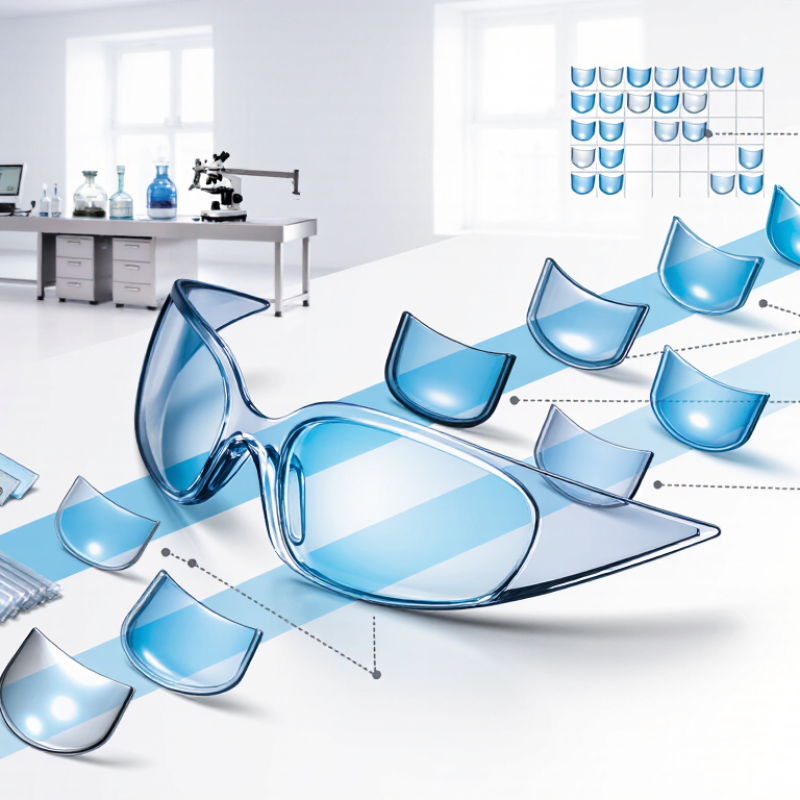
Orthokeratology Lens Manufacturing in China: An Industry Overview
China’s orthokeratology lens sector combines optical design, precision machining, surface finishing, and inspection. A lens may look tiny, but its back surface needs carefully controlled curves and smooth edges. Manufacturers typically assess dimensions, optical power, and material properties against defined specifications. ISO 18369 provides an international framework for contact-lens vocabulary, measurement, and tolerances. Public industry reports do not consistently separate China’s orthokeratology output from broader contact-lens production, so precise national production figures are difficult to verify.
Demand is shaped partly by myopia management. Holden and colleagues’ 2016 analysis, published in Ophthalmology, estimated that 2.6 billion people were myopic in 2020 and projected 4.8 billion by 2050. These are global population estimates, not orthokeratology sales forecasts. They do, however, help explain manufacturers’ focus on repeatable production and traceable quality checks. Small variations matter. So does clear documentation of materials, inspection methods, and batch records.
Tips: When assessing a manufacturer, ask for documented quality procedures, measurement records, and evidence of consistent production. Compare details, not just catalog claims. A polished sample is useful, but it cannot reveal every process weakness. That limitation deserves attention.
Best Orthokeratology Lens Manufacturers in China
Core Technologies and Manufacturing Standards
Reliable orthokeratology lenses depend on precise reverse-geometry design, not simply polished surfaces. Manufacturers need to control base-curve geometry, sagittal depth, peripheral alignment, and edge lift. Small deviations matter. They can affect centration, tear exchange, and overnight comfort. Computer-controlled lathing helps maintain repeatable dimensions, while optical inspection can detect scratches, chips, and surface irregularities before packaging.
Quality systems matter just as much. Buyers can ask whether production follows ISO 13485 medical-device quality management practices and uses applicable ISO 18369 contact-lens test methods. Useful evidence includes documented dimensional checks, material traceability, validated cleaning and packaging processes, and batch-level inspection records. Oxygen permeability and lens material should also be assessed against the intended wearing schedule. A certificate alone is not proof of consistent performance; review actual test methods and records.
Demand makes these controls increasingly relevant. Holden et al.’s 2016 projection in Ophthalmology estimated that nearly 4.8 billion people could have myopia by 2050, about 49.8% of the global population. This is a projection, not a guarantee of future demand. Manufacturing quality cannot replace clinical fitting or follow-up. It can, however, support more consistent lenses. There is still room to improve: manufacturers should explain tolerances clearly, rather than relying on broad claims of precision.
| Evaluation dimension | Core technology or manufacturing practice | Relevant standard or verification |
|---|---|---|
| Reverse-geometry design | The lens design typically includes a central treatment zone, a reverse curve, an alignment zone and a peripheral edge-lift zone. Geometry is selected to support corneal reshaping during wear and tear exchange beneath the lens. | Review design documentation, fitting guidance and performance evidence for the specific registered product; fit must be assessed by a qualified eye-care professional. |
| Optical and geometric parameters | Production controls commonly cover base curve, reverse-curve geometry, optical-zone diameter, total diameter, center thickness and specified power. Limits are product-specific rather than universal. | Dimensional and power tolerances can be assessed against applicable requirements in the ISO 18369 contact-lens series and the product’s approved specifications. |
| Oxygen performance | Material oxygen permeability (Dk) and lens oxygen transmissibility (Dk/t) are relevant design and safety characteristics. Dk/t depends on lens thickness as well as material properties. | Check test methods, reported units, sample conditions and product-specific evidence; do not compare Dk and Dk/t as if they were the same measurement. |
| Material and surface quality | Controlled polymer formulation, clean material handling and consistent machining and polishing help achieve the specified optical surface and reduce visible defects. | Relevant ISO 18369 methods address contact-lens material and physical-property testing. Review inspection criteria and batch records for the finished product. |
| Precision machining | Computer-controlled lathing and controlled finishing can support repeatable lens geometry. In-process checks help detect deviations before final release. | Look for documented equipment calibration, process validation, inspection records and acceptance criteria tied to approved product specifications. |
| Metrology and final inspection | Final checks may include lens power, dimensions, surface condition, edge quality and visual defects, using calibrated measurement equipment and defined sampling plans. | ISO 18369-2 and ISO 18369-3 provide relevant tolerance and measurement-method references; the applicable edition and product requirements should be confirmed. |
| Sterilization and packaging | Where a product is supplied sterile, the sterilization process, sterile-barrier packaging and shelf-life claims require appropriate validation and controls. Follow the product label for storage and use. | Verify the registered product’s labeling, packaging integrity controls, sterilization validation and stated expiry period; requirements are product-specific. |
| Quality management system | A controlled quality system should cover supplier qualification, document control, production records, nonconformities, corrective actions, complaints and traceability. | ISO 13485:2016 is a recognized medical-device quality-management-system standard. Certification alone does not replace product registration or regulatory compliance. |
| China regulatory status | Orthokeratology lenses are regulated medical devices in China. Manufacturers and products must meet applicable NMPA registration, production and quality-management requirements. | Confirm the current NMPA registration status and approved indications, labeling and instructions for use for each specific product. |
| Traceability and post-market monitoring | Batch identification and complaint-handling processes support investigation of quality issues and ongoing safety monitoring after market release. | Review lot or batch traceability, complaint procedures, adverse-event handling and recall processes under applicable Chinese regulations. |
Note: Standards and regulatory requirements may be revised. Confirm the current requirements and the registration details applicable to the specific product before procurement or clinical use.
China’s leading orthokeratology lens manufacturers should be assessed by more than production capacity. Look for documented quality controls, consistent lens geometry, material oxygen-transmission data, and traceable batch records. A capable supplier should also provide fitting guidance and clear procedures for handling lens or fit concerns. Details matter: a small change in lens parameters can affect centration and overnight comfort.
The International Myopia Institute’s 2019 clinical management report notes projections that myopia may affect about half the world’s population by 2050. This growing need makes reliable lens design and clinical support important, but it does not establish a ranking of Chinese manufacturers. Buyers should request current technical files and independent test results, then compare them against the intended clinical workflow. That distinction is easy to miss. Available public information may not allow a fair manufacturer-to-manufacturer comparison.
Tips: Ask for oxygen-permeability results, material specifications, quality-system documentation, and sample traceability. Have an eye-care professional confirm fitting and follow-up requirements. A polished catalogue is useful, but it is not clinical evidence.
In China, orthokeratology (ortho-k) lenses are generally rigid gas-permeable lenses with reverse-geometry designs. They reshape the central cornea overnight, allowing many wearers to see clearly during the day without spectacles. Common types include spherical designs for relatively regular corneas, toric designs for greater corneal astigmatism, and customized designs guided by corneal topography. The distinction is not always neat. Lens choice depends on eye shape, prescription, tear film, and clinical goals.
For children with progressing myopia, ortho-k can provide daytime vision correction and support myopia management; it is not a cure. The International Myopia Institute’s 2019 Clinical Management Guidelines summarize studies reporting about 0.15 mm less axial elongation over two years in some ortho-k groups than in controls. Results vary. Age, starting prescription, adherence, and follow-up can affect outcomes, so this figure should not be promised to an individual patient.
Product evaluation should extend beyond oxygen permeability and correction range. Clinicians typically review corneal topography, lens centration, fluorescein patterns, and ocular surface health after fitting. A decentered lens may cause halos or uneven vision. The IMI’s 2019 report projected nearly five billion people with myopia by 2050, underscoring the need for scalable, carefully monitored options. Access is not the same as suitability.
A general guide to common design types and their typical clinical uses—not a comparison of manufacturers or treatment effectiveness.
A value of 1 indicates a common application; 0 indicates it is not a typical application for that design category. Actual suitability depends on corneal shape, prescription, lens fitting, and clinician assessment.
For a Chinese orthokeratology lens manufacturer, quality review should begin with documents, then move to the production floor. Holden and colleagues projected 4.758 billion people would have myopia by 2050, including 938 million with high myopia (Ophthalmology, 2016). That forecast raises the stakes for reliable lens design and manufacturing. It does not prove that any single lens works.
Check that the manufacturer’s NMPA registration covers the exact lens model, intended use, and production site. Review the scope and validity of its ISO 13485 quality-management certification. Ask for test records covering lens dimensions, oxygen transmissibility, material properties, surface finish, and packaging integrity. Match sample results to batch records. Look closely. A certificate alone cannot show whether routine production stays within specification.
A site audit can reveal practical details: calibrated measuring equipment, controlled work areas, staff training records, and procedures for handling complaints. Request evidence that adverse events are reviewed and corrective actions are documented. Compare technical files with labels and instructions for use; small mismatches matter. One uncomfortable caveat: polished audit documents may still leave gaps in daily practice. Independent testing can help, though it adds time and cost. Verify the evidence yourself.
They are rigid, gas-permeable lenses with reverse-geometry designs. They gently reshape the central cornea overnight, supporting daytime vision without spectacles. The effect is temporary.
Spherical designs may suit relatively regular corneas. Toric designs can address greater corneal astigmatism. Customized designs may use corneal topography. The categories can overlap.
Production combines optical design, precision machining, surface finishing, and inspection. Manufacturers check dimensions, optical power, and material properties against specifications. Small differences matter.
Ask for documented procedures, measurement records, material specifications, and traceable batch information. Independent test results can add useful evidence. A polished sample proves little about every production batch.
They may review corneal topography, lens centration, fluorescein patterns, and ocular surface health. Follow-up matters. A decentered lens can cause halos or uneven vision.
It can correct daytime vision and may help slow eye growth in some children. It is not a cure. Outcomes vary with age, prescription, adherence, and follow-up.
Some studies reported about 0.15 millimeters less axial elongation over two years compared with control groups. That is a group result, not a promise for one child.
Public reports do not consistently separate orthokeratology lenses from broader contact-lens production. Precise national totals are difficult to verify. That gap deserves attention.
China’s orthokeratology lens industry combines specialized optical design, precision manufacturing, and quality control to produce lenses intended for overnight corneal reshaping under professional supervision. This overview explains the core technologies and manufacturing standards involved, including how consistent materials, accurate geometry, and reliable production processes contribute to lens performance and user safety.
It also examines the main types of orthokeratology lenses and their clinical applications, while outlining practical ways to assess manufacturers. Buyers and eye-care professionals can consider production capabilities, quality management, technical support, and relevant regulatory documentation when comparing suppliers. Understanding these factors helps readers make informed evaluations without treating manufacturing claims as a substitute for clinical advice or proper fitting by a qualified eye-care professional.

Chroma Lenses