Global sourcing has changed how brands evaluate everyday optical accessories. A Contact Lens Case may look simple, yet its design affects hygiene, user convenience, packaging efficiency, and product reputation. Buyers often compare materials, sealing performance, manufacturing consistency, and supplier communication before placing an order. Small details matter. A secure cap. Smooth interior surfaces. Clear labeling.
Experienced sourcing teams usually begin with documented specifications and realistic quality standards. They review material certifications, production samples, inspection reports, and packaging conditions. Food-grade or medical-use suitability may matter, depending on the intended market and product claims. Reliable suppliers should explain their processes clearly, provide traceable batch information, and respond consistently when samples require changes. These steps support more informed purchasing decisions and reduce avoidable quality risks.
Global sourcing can also improve cost control, customization, and supply flexibility. Manufacturers in different regions may offer varied colors, molds, printing options, and order quantities. However, lower prices do not automatically indicate better value. Shipping delays, inconsistent samples, unclear tolerances, or weak after-sales support can change the final cost. This part is often underestimated. A carefully selected supplier should balance price with quality, compliance awareness, production capacity, and communication. Buyers must still verify claims independently, because no supplier relationship removes the need for inspection. For that reason, choosing a Contact Lens Case through global sourcing requires practical experience, technical judgment, and a willingness to question convenient assumptions. It is efficient when managed carefully, but never effortless.
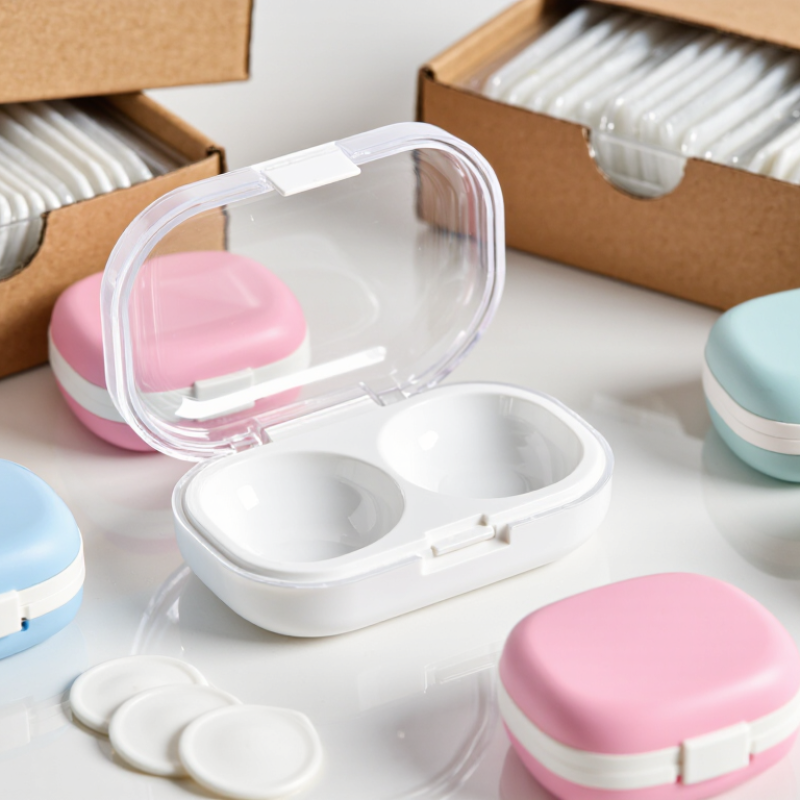
The demand is substantial. The CDC reports that about 45 million people in the United States wear contact lenses. This figure shows why contact lens cases remain practical, recurring healthcare accessories. The CDC also found that 99% of surveyed wearers reported at least one risky hygiene practice. These findings create a clear need for cases that support daily cleaning, drying, and replacement routines. A reliable case should close securely, resist leakage, and provide separate chambers for each lens.
Global sourcing can help buyers compare materials, production capacity, and packaging options across markets. However, lower pricing should not become the only decision factor. FDA guidance emphasizes proper lens and case hygiene, including regular case replacement. Suppliers should provide material information, quality inspection records, and consistent dimensions. Small defects matter. A loose cap can damage trust quickly.
Tips: Ask for samples before placing large orders. Check thread strength, seal performance, surface smoothness, and odor. Request batch-level inspection data. CDC research is authoritative, but it does not remove every sourcing uncertainty. Buyers should still verify factory controls, shipment conditions, and local compliance needs. I would also avoid excessive packaging unless protection requires it. That choice may reduce waste, though the best balance is not always obvious.
A contact lens case is a small product with a serious hygiene responsibility. The FDA recommends replacing lens cases at least every three months. This guidance matters because bacteria and deposits can collect inside corners, threads, and drainage areas.
A new case should be clean, leak-resistant, and easy to rinse. Smooth inner surfaces help reduce residue buildup. Secure caps can prevent solution loss during travel. However, no design removes the need for regular replacement. Even a case that looks clear may hold invisible microorganisms. Looks can deceive.
For global sourcing, buyers should check material safety, production consistency, and packaging protection. Suppliers should provide clear care instructions and reliable quality records. The case should tolerate repeated rinsing without cracking or warping. It should also dry effectively between uses, since trapped moisture can support microbial growth. These details affect user safety more than decorative features.
A practical routine is simple: empty the case after use, rinse it with fresh contact lens solution, and leave it open to air-dry. Do not refill old solution. Do not use tap water unless healthcare guidance specifically permits it. Replacing the case every three months remains important, even with careful cleaning. In reality, users may forget the date, so sourcing teams could add a visible replacement reminder. That small feature may be imperfect, but it can encourage better habits.
| Evaluation Dimension | Verified Safety or Sourcing Requirement | Recommended Purchasing Specification | Global Sourcing Checkpoint | Priority | Reference |
|---|---|---|---|---|---|
| Replacement cycle | Contact lens cases should be replaced at least every three months to reduce contamination risk. | Print a clear “Replace every 3 months” reminder on the package or instruction card. | Confirm that the replacement instruction is consistent across packaging, inserts, and product listings. | Critical | U.S. Food and Drug Administration; CDC contact-lens-care guidance |
| Cleaning and drying | The case should be emptied, rinsed with fresh contact-lens solution, and allowed to air-dry after use. Tap water should not be used for cleaning contact lenses or lens cases. | Provide a smooth, easy-to-rinse interior and instructions that specify fresh contact-lens solution and air-drying. | Review the instruction language and inspect the case for seams, recesses, or surfaces that may retain residue. | Critical | U.S. Food and Drug Administration; CDC contact-lens-care guidance |
| Case separation | A two-compartment case helps keep the right and left lenses separated during storage. | Use clearly marked compartments, such as “R” and “L,” with legible, durable markings. | Check marking visibility after repeated opening, washing, and handling tests. | High | Common contact-lens case safety practice |
| Leak prevention | A secure, properly fitting lid helps keep storage solution inside the case and limits exposure during transport. | Specify compatible threads or closures, a continuous sealing surface, and a leak-resistance test before shipment. | Request test conditions, sample results, and packaging protection for international transport. | High | Product safety and packaging quality requirement |
| Material suitability | Materials that contact storage solution should be selected for chemical compatibility, cleanliness, and durability. | Require a documented material specification, colorant information, and confirmation that the material is suitable for the intended use. | Obtain material declarations and verify that the production material matches the approved sample. | High | Supplier quality-control requirement |
| Hygienic production | Packaging and handling should prevent visible dirt, moisture, foreign particles, and other contamination before use. | Use individually protected packaging and define acceptance criteria for cleanliness, odor, deformation, and foreign matter. | Audit the production and packing process, especially storage areas and final inspection procedures. | High | General medical-product hygiene and quality practice |
| User instructions | Users need clear guidance to avoid sharing cases, use fresh solution, and follow the recommended replacement schedule. | Include concise multilingual instructions covering cleaning, air-drying, no tap water, no sharing, and three-month replacement. | Check translation accuracy and ensure instructions remain readable after packaging reduction or localization. | High | U.S. Food and Drug Administration; CDC contact-lens-care guidance |
| Packaging sustainability | Packaging should protect the case from contamination while avoiding unnecessary material and excessive volume. | Consider recyclable packaging formats where local recycling systems support them, without compromising hygiene protection. | Confirm packaging material identification and assess carton volume for international shipment efficiency. | Medium | Sustainable packaging design consideration |
| Quality inspection | Consistent dimensions, closure performance, markings, and cleanliness are essential for repeat purchasing. | Use a pre-shipment checklist covering visual defects, lid fit, leakage, compartment markings, packaging, and instruction inserts. | Approve a reference sample and require documented corrective action for nonconforming batches. | High | Supplier quality-assurance practice |
| Inventory planning | Because cases are recommended for replacement every three months, recurring demand can be planned around quarterly usage. | Set replenishment forecasts in three-month intervals and maintain safety stock according to actual demand and shipping time. | Separate forecast assumptions from confirmed purchase quantities and review consumption by market. | Medium | Planning implication based on the three-month replacement guidance |
A contact lens case is small, but its manufacturing controls should not be. The CDC estimates that about 45 million people in the United States wear contact lenses. Its research also found that nearly all surveyed wearers reported at least one risky care behavior. A poorly finished case can add another avoidable concern.
ISO 13485:2016 provides a practical quality benchmark for medical-device manufacturing. It emphasizes documented processes, risk management, supplier evaluation, traceability, corrective action, and controlled production environments. For global sourcing, these controls make factory performance easier to compare across regions.
A capable manufacturer should show inspection records, material specifications, cavity checks, leak testing, and batch identification. Small details matter.
A clean hinge. A stable thread. No sharp edge.
ISO 13485 certification does not automatically prove that every contact lens case is safe or suitable. It confirms a quality management system, not perfect output. Buyers still need independent sampling, packaging reviews, and production audits.
That is the uncomfortable part. Paperwork can look complete while daily control remains inconsistent.
The ISO Survey and ISO 13485 requirements can guide supplier screening, but practical verification must continue. Global sourcing works better when evidence is checked, not simply trusted.
Why Choose a Contact Lens Case for Global Sourcing?
Material Economics: PP Enables Lightweight, Cost-Efficient Case Production
For global sourcing, polypropylene, or PP, offers a practical balance between weight, strength, and price. Its low density reduces shipping weight without making the case feel fragile. This matters when thousands of cases move through warehouses, ports, and retail channels. PP also supports efficient injection molding, allowing consistent shapes and fast production cycles.
In production reviews, I would examine wall thickness, lid alignment, and thread performance before approving a supplier. These details affect daily use more than a polished sample does. A well-designed PP case can use less material while maintaining a firm seal. It can also support clear color separation for the two compartments. Tooling costs still require attention, especially when custom molds or several sizes are involved. Small design changes may create large cost differences.
PP is not perfect. Thin sections can warp if cooling is poorly controlled. Hinges may weaken after repeated opening, and recycled content can vary between batches. A reliable sourcing process should include dimensional checks, leak testing, drop testing, and material documentation. Ask for production samples, not only prototype pieces. That extra step reveals defects that photographs usually hide. Cost matters, but stable quality protects the broader supply chain.
Polypropylene (PP) has a typical density of approximately 0.90 g/cm³, lower than commonly used alternatives such as HDPE, ABS, and polycarbonate. For a contact lens case with the same volume, this lower density can reduce material mass, shipping weight, and handling costs. Actual performance and cost depend on the selected grade, wall thickness, tooling, and regional resin prices.
Why Choose a Contact Lens Case for Global Sourcing?
Sourcing Decision: MOQ, Compliance, Lead Time, and ROI Compared
A contact lens case looks simple, but global sourcing requires careful commercial judgment. MOQ directly affects cash flow, storage space, and product testing. A low MOQ reduces inventory risk, yet it can increase unit costs and limit customization. A high MOQ may improve pricing, but unsold stock can quietly damage ROI.
Compliance must be checked before production, not after shipment. Confirm material specifications, hygiene requirements, labeling rules, and testing documents for each target market. Ask suppliers for traceable records and independent laboratory reports. Lead time also needs practical planning. Include sampling, tooling, production, inspection, customs clearance, and possible port delays. A rushed order often creates expensive compromises.
Tips: Compare total landed cost, not only factory pricing. Request a pre-production sample and inspect its hinge, seal, threading, and surface finish. Keep written approval records. Add safety stock when demand forecasts are uncertain.
ROI should include defect rates, freight, inspections, returns, and customer complaints. A cheap case with poor closure performance may create repeated losses. In real sourcing projects, specifications sometimes change after sampling. That is normal, but ignoring the change is not. Review MOQ, compliance evidence, and delivery assumptions together before signing a purchase agreement.
It is small, but manufacturing control still matters. Poor finishing can create avoidable problems. Check the hinge, thread, and edges carefully.
It indicates a documented quality management system for medical-device production. It covers risk management, supplier evaluation, traceability, and corrective action. It does not guarantee perfect products.
Request inspection records, material specifications, cavity checks, leak tests, and batch identification. Production samples are more useful than polished photographs.
No. A certificate supports supplier evaluation, but independent sampling and production audits remain necessary. Paperwork may look complete while daily control is inconsistent.
Polypropylene is lightweight, reasonably strong, and cost-efficient. Its low density can reduce shipping weight. It also supports fast injection molding.
Check wall thickness, lid alignment, thread performance, and compartment separation. A firm seal matters more than an attractive sample. Small details affect daily use.
Thin sections may warp when cooling is poorly controlled. Hinges can weaken after repeated opening. Material properties may also vary between batches.
Use dimensional checks, leak testing, and drop testing. Review packaging and material documents. I would not approve a supplier from one sample alone.
Yes. Custom molds and multiple sizes can increase tooling expenses. A small wall-thickness change may alter material use, strength, and production cost.
Trust must be supported by evidence. Audits, samples, and records can still miss occasional defects. The process should be reviewed again.
Choosing a Contact Lens Case for global sourcing is supported by strong market demand, practical safety needs, and scalable manufacturing advantages. With millions of contact lens users in the United States and many more worldwide, replacement cases represent a consistent product opportunity. Since lens cases should be replaced regularly, buyers need dependable products that support daily hygiene and convenient use. Manufacturing aligned with ISO 13485 principles can strengthen quality control, improve process consistency, and help meet the expectations of international customers.
Polypropylene (PP) is a practical material because it is lightweight, durable, and cost-efficient for high-volume production. When evaluating suppliers, companies should compare minimum order quantities, compliance documentation, production quality, lead times, packaging options, and total return on investment. A well-planned sourcing decision balances unit price with reliability, safety, delivery performance, and long-term supply stability, helping businesses select a Contact Lens Case solution that is competitive and suitable for different markets.

Chroma Lenses